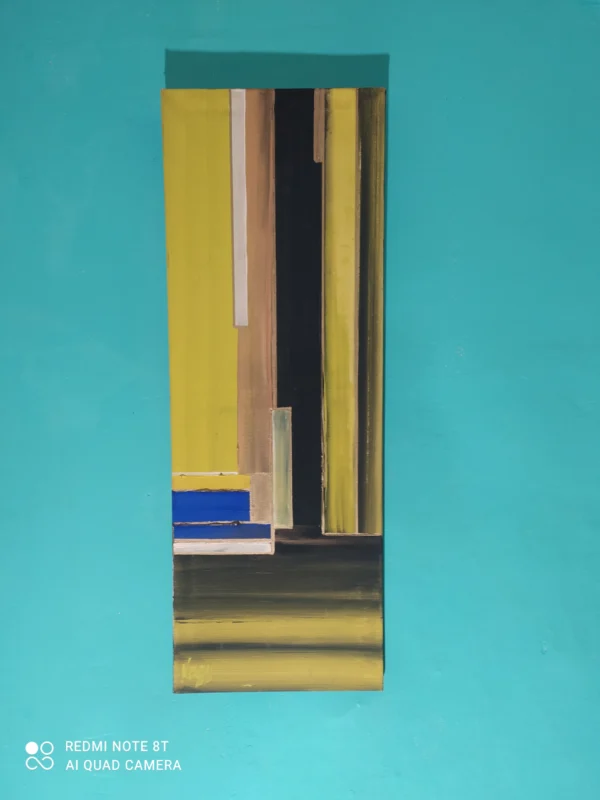
Kafka
By Urs Jaermann
Kafka is a work that unites narrative complexity with expressive abstract forms, mirroring the existential motifs often found in Franz Kafka’s own literature. The piece, brought to life by Urs Jaermann, takes the viewer through a vivid journey across color and gesture that feeds into Kafkaesque themes of ambiguity, transformation, and the search for meaning in the face of inscrutable realities.
- Free shipping in Switzerland
- No Hassle Refunds
- Secure Payments
- Established Artist


Urs Jaermann’s painting “Kafka” utilizes swirling hills and intense color gradients to represent an inner psychological landscape, akin to the realities Kafka constructed in his writing. The painting is tripartite, with the central section dominated by luminous greens, while browns and ochres build depth on the right and ochres fade softly into the left. The sky, painted in broad, expressive blues, pinks, and purples, contrasts strikingly with the earthy motif below, embodying a sort of tension between the known and the unknown.
Sporadic lines of text flow along the curved horizon, reminiscent of Kafka’s narrative style, in which prose often winds labyrinthine paths. The visual turbulence reflects existential uncertainty, much like the characters and circumstances Kafka presents—always striving for meaning while confronted by ambiguity and overwhelming forces.
Thematic resonance with Franz Kafka
Franz Kafka’s writing is marked by a persistent crossing of boundaries—human and animal, reality and surreal, autonomy and oppression. Jaermann’s Kafka channels these tensions through visual dissonance and the sense of being enveloped by the environment, as seen in the painting’s enveloping hills and restless brush strokes. The green, living center seems caught between opposing slopes, echoing Kafka’s perennial themes of struggle and ambiguity, as well as the liminality of existence.
Just as Kafka blurred lines between categories in his literature to challenge anthropocentric perceptions and confront the ineffability of existence, Jaermann’s painted forms resist simple interpretation. The lack of distinct figures pushes the viewer into a reflective state, paralleling Kafka’s readiness to destabilize and question the ordinary through disorientation and symbolic layering.
Painting as psychological and philosophical exploration
The curved inscriptions, placed like a refrain along the ridge, carry philosophical undertones and invite a deeper interrogation of meaning, redemption, and identity—echoing the introspective drive of Kafka’s characters. The movement of the hills and the intensity of the sky create a sense of perpetual motion and unrest, reinforcing the fundamental themes of alienation and the quest for understanding prevalent throughout Kafka’s oeuvre.
Urs Jaermann’s Kafka hence serves as a visual meditation on transformation and existential encounter; the merging of landscape and psyche within the painting mirrors Kafka’s capacity to turn everyday life into a mysterious psychological event. The choice of colors, the energetic application, and the textual elements all contribute to a sense of coming-to-terms with existential anxiety—a central motif not only in Kafka’s work but also in the broader tradition of modernist art and literature.